

Among the many effects of digital transformation is the strong boost it has given to projects aimed at improving communications in less-connected parts of the world and in developing hubs.
Many parts of Latin America and the Caribbean that were previously underserved are beginning to feel this impact. One country that is increasingly positioning itself on the global map is Ecuador, thanks to new submarine cable projects in and around the country.
One of the most important is Carnival Submarine Network-1 (CSN-1), a 4,500 km cable connecting Ecuador, Panama, Colombia and the west coast of Florida, with branching units toward Central and South America. Construction began in 2022, and it is expected to enter into service in the first half of 2026.
Boosting communications
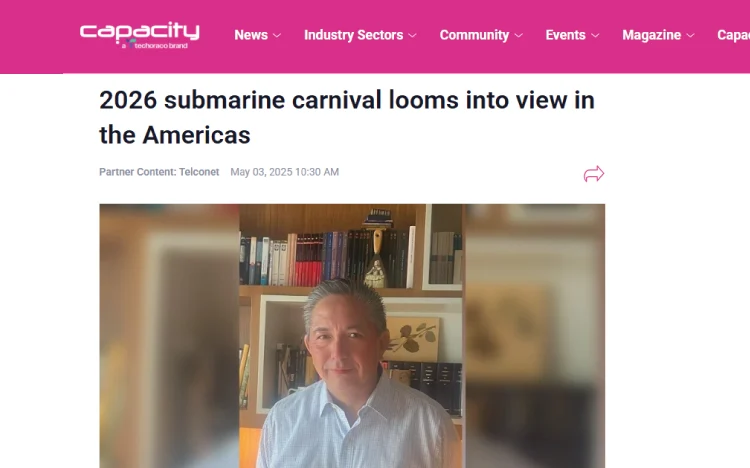
CSN-1 is a project of the Ecuadorian infrastructure and telecommunications operator Telconet, in collaboration with Alcatel Submarine Networks. Once operational, Carlos Pazmiño, CSN-1 project lead at Telconet, expects it to usher in a new era of communications for Ecuador and other parts of the region.
“If you look at the region's infrastructure maps, every day there are more networks connecting people within countries. As these networks become fiber optic cables, the trend is to require more and more international connectivity.”
Before the start of this decade, Pazmiño recalls, submarine cables between the US and South America used to bypass Ecuador, landing in Peru —the country's much larger neighbor— or in Chile, further south. However, as global demand from carriers, enterprises and large cloud providers for denser networks with greater redundancy and resilience has grown, new opportunities have emerged.
“Ecuador wasn't talked about much,” says Pazmiño. “That's why, in 2020, we decided to move forward with this initiative to give Ecuador more connectivity and find new connection solutions for Central America and the Caribbean.”
Not one, but two cables
For this reason, Telconet already has plans for another submarine cable, CSN-2, which will run 1,700 km from Veracruz, Mexico, to Apalachee Beach, Florida. Besides further improving connectivity in Central America, this cable will help meet growing demand from data centers in Querétaro, Mexico.
CSN-2 timelines are not yet confirmed, but once in service it will open up new opportunities. Both cables will also complement the 6,000 km Pacific Caribbean Cable System (PCCS), of which Telconet was a founding member in 2015, connecting Ecuador, Panama, Colombia, Aruba, Curaçao, the British Virgin Islands, Puerto Rico and the United States.
“Today you can't talk about connectivity with a single system; you need several systems to guarantee redundancy and reliability,” explains Pazmiño, who is also chairman of the PCCS cable.
He says part of Telconet's mission is to open opportunities in the Caribbean between the US and Ecuador, after seeing many Caribbean initiatives before 2020 but little real activity. Pazmiño believes his company's decision to move forward gave it an advantage over other players in the region that later announced similar projects.
A new lifespan
In addition, several existing cables between these regions are reaching the end of their useful life or are relatively old, making updated infrastructure necessary to support an increasingly AI-centric world. Meanwhile, Ecuador's geographic location, close to the Caribbean and Central America, offers a strategic position as a transit platform between regions.
Pazmiño also mentions two new data centers Telconet is building in Ecuador, in addition to the two it already owns, along with data-center-type facilities being created at the landing stations in Ecuador and other countries. All this will help increase connectivity in the region, creating opportunities for large tech companies as well as smaller customers seeking to serve rural and underserved areas.
“Telconet is a company that has always worked with state-of-the-art solutions,” says Pazmiño. “The idea is to offer these services regionally and, ultimately, improve the lives of end users.”
Source: Capacity Media