

With an informal style and a broad smile, Telconet S.A. general manager Tomislav Topic welcomed us to his facilities in northern Guayaquil on June 20. We climbed several steps to enter a conference room.
There, Topic turned on his laptop and projected his new investment on a digital whiteboard: the new submarine cable (Carnival Submarine Network-1, CSN-1).
“It will allow us higher speeds than we have now, and we built it for redundancy. It is better to have two separate submarine cables on different routes. (For example), if a tsunami hits Manta and damages the cable, we already have the other one,” said Topic while showing its route on the whiteboard.
He immediately raised an eyebrow at that possibility and said that damage to these cables could last weeks or even months, which is why it was necessary to have two. “The internet is so important; you can go without water, but not without internet,” he said with a slight smile.
Topic explained that the submarine cable starts in Ecuador, continues to Panama, then forms an inverted “Y” connecting to Colombia, with the other end reaching the west coast of Florida. It is a private investment of 300 million dollars, is being manufactured in France and is 4,500 kilometers long.
Work is expected to begin in the first quarter of 2025 to then lay it on the seabed. “It is a custom-made cable, it already comes cut; it just needs to be laid,” he said, adding that this work is carried out by Alcatel Submarine Networks' ships.
Its relationship with Artificial Intelligence
Ecuador is one of the countries already venturing into Artificial Intelligence (AI): universities already offer degrees that teach students to use these tools, companies use it to automate tasks, and even ordinary citizens have learned to use ChatGPT to answer their questions.
The new submarine cable will enable that agility, said Topic, who sees it as a great opportunity. “If Ecuador takes the leap into Artificial Intelligence, we will no longer depend on foreign companies that come to sell systems or software, because we will be able to develop them ourselves with the support of AI; we won't have to pay anymore,” he said, also mentioning the possibility of selling internet to other nations: “because that cable feeds the whole Caribbean.”
While discussing these advances, Topic recalled the previous fiber optic cable, developed more than 10 years ago by the PCCS Consortium (made up of Telconet, Cable & Wireless, Setar of Aruba, Telefónica Global Solutions and United Telecommunication Services of Curaçao), and said its lifespan is 25 years, meaning about 15 years remain.
Telconet is a telecommunications operator providing telecommunications and digital services. It started almost 40 years ago with Telcodata selling computers and by 2025 would have two submarine cables.
Where does the information go?
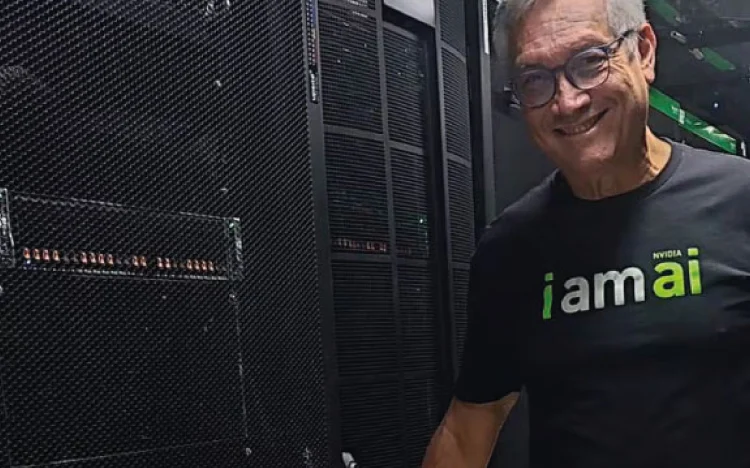
Telconet has two data centers, one in Guayaquil and another in Quito. Topic showed this newspaper the servers at the Guayaquil data center, explaining that several layers of security are needed, consisting of huge, resistant doors.
After passing several of them you reach the heart of the information: a large number of servers, each kept at the right temperature to prevent failures.
“The power can never go out; if there is an earthquake nothing can happen, communication can't be lost, the air conditioning can't go out,” said Topic as he opened a small transparent door leading to one of the aisles of data storage equipment, where cold and warm air circulated.
“This is where Netflix movies, bank (transactions) and the energy-hungry NVIDIA systems are,” Topic explained while pointing at equipment holding vast amounts of information.
In that space there were about 20 NVIDIA systems, designed for accelerated computing, from the company that had already overtaken tech giants such as Microsoft.
Read the full story in El Universo (Spanish)